
About Us
Church History
A documented journey from Sabbath-keeping roots to the Mother Church of Seventh-day Adventists in South India.
The Land, the People and the Pre-Adventist Christian Setting
Pragasapuram stands within the historic Christian landscape of southern Tamil Nadu, in the wider Tirunelveli/Thoothukudi–Nazareth area. By the late nineteenth and early twentieth centuries, Protestant missions had already established churches, schools and other institutions in the region. Christianity was therefore not a new presence when Adventist missionaries arrived. Bible reading, Christian education and organized congregational life were already familiar features of community life.
This setting matters because the Adventist story at Pragasapuram did not begin with outsiders creating a Christian community from nothing. It developed through contact with an existing Indian Christian community that had already developed distinctive convictions concerning the Sabbath and biblical practice. This community consisted of Sabbath-observing Christians; Encyclopedia of Seventh Day Adventist (ESDA) identifies them as a group among the Nadars commonly described in historical sources as "Hindu Christians," associated with the Nattu Sabai or related local Christian movement. The geographical setting also helped.
Pragasapuram and the neighbouring villages were connected to a wider network of Christian communities in the Tirunelveli/Thoothukudi region. The area offered access to villages, a population familiar with Christian teaching, and the possibility of combining preaching, education, health service and practical work. These factors later allowed the Pragasapuram mission to become a base from which workers could travel into the surrounding Tamil field. The significance of Pragasapuram is consequently rooted both in place and people.
The site became important because a local Christian community was receptive to further Bible study, because the Adventist missionaries were prepared to work within that environment, and because the resulting congregation eventually became the institutional starting point of organized Adventism in South India. The church should therefore be understood first as a community of believers and only second as a building. The later historic church structure, the school, hostels and other facilities are physical expressions of a movement that had already begun through relationships, Bible study, worship and personal conviction.
The Sabbath-Keeping Community and the Sattampillai Heritage
One of the most important additions supplied by the wider research is the story of the indigenous Sabbath-keeping background. ESDA records that a group among the Nadars of Tamil Nadu observed the seventh-day Sabbath before Adventist missionaries arrived. The movement was associated with Arumainayagam Sattampillai, also known as Arumai Nayakam Sattampillai and Sathyanathan Pilla. According to ESDA, Sattampillai had worked within the Protestant Christian environment of the region before breaking with European missionary authority.
He sought an Indian expression of Christianity and established an independent "Hindu Church of Lord Jesus," using "Hindu" in a geographical and cultural sense rather than as a statement of conversion to Hinduism. His movement incorporated practices that its members understood to have Old Testament foundations, including seventh-day Sabbath observance. The Sabbath-keeping community developed before the arrival of the American Adventist missionaries. This is historically important because it explains why the James family encountered people who already regarded Saturday as sacred.
ESDA reports that Adventist ministers who visited the community in 1907 found several practices that were closely aligned with Adventist convictions, including Sabbath observance, baptism by immersion, tithes and offerings, reverence for the house of God, congregational organization and a church-school system. The contact between these believers and Adventists was not accidental. In the 1890s, information about Sabbath keepers in India reached Adventists in the United States. A letter seeking information and literature was addressed to "Seventh-day Keepers" in New York and reached the Adventist General Conference.
Adventist literature consequently began to circulate among Sabbath keepers in South India. By 1905 Adventist workers in Ceylon had also encountered related Sabbath-keeping people. The story of Sattampillai should be presented carefully. It is part of the background to Pragasapuram, not a claim that the pre-Adventist Nattu Sabai was already a Seventh-day Adventist congregation.
The historical importance lies in the preparation of a community already committed to Sabbath observance and open to further biblical study. The later Pragasapuram church emerged through a process of contact, teaching, baptism, organization and integration into the Adventist denomination. In this sense, the Mother Church has two intertwined roots: an indigenous Christian search for biblical faithfulness and the arrival of organized Adventist missionary work. The meeting of those two streams forms one of the most distinctive features of the Pragasapuram story.
The Adventist Connection Before the James Family
The wider Adventist movement had already developed an international missionary vision by the end of the nineteenth century. Adventist work in India expanded through literature, personal evangelism and missionary appointments. South India became increasingly important because of its established Christian communities and the presence of people who were already observing the Sabbath. The key turning point came in 1906, when Judson Spray James and Minnie Louise James arrived in India.
The later ESDA account adds an important detail: in December 1907, James travelled with John L. Shaw and G. F. Enoch to visit the Sabbath-keeping community in the Tirunelveli/Thoothukudi region.
James was studying Tamil in Bangalore, and his language teacher knew of the Sabbath keepers and helped establish the connection. The visit of James, Shaw and Enoch was therefore a reconnaissance as well as a religious encounter. They were able to observe a community whose beliefs included several elements that Adventists recognized as significant. The meeting opened the way for a permanent missionary presence.
The supplied history records that in December 1907 James, Shaw and Enoch visited the Sabbath-keeping community and that ESDA records March 17, 1908 as the date on which Judson and Minnie James moved into the area. The two dates should not be confused. December 1907 marks the exploratory visit; March 1908 marks the establishment of the James family's residence and active work among the people. The local community's welcome was central.
According to ESDA, the group vacated a school building so the missionary family could live there and provided land for the mission. The Koilpillai family also played an important role in helping James obtain land and establish the early mission facilities. The partnership between local believers and the missionaries is therefore a defining feature of the beginning of Adventism at Pragasapuram.
Judson Spray James and Minnie Louise James: The Pioneering Household
Judson Spray James and Minnie Louise James should be remembered together. The Pragasapuram mission was not simply the work of a preacher. It was a household-based ministry in which evangelism, education, language work, health service and practical institution-building were closely connected. James conducted Bible studies and organized the early mission.
Minnie James developed a special interest in the education of girls. ESDA records that she gathered six teenage girls and arranged for Mrs. Joseph to instruct them. The girls met in a room of the James bungalow and on the verandah, without fees.
At the same time, Judson James conducted Bible studies on the verandah, drawing people into sustained discussion. The image of the verandah is one of the most enduring symbols in the history of Pragasapuram. The same physical space could function as a classroom and a place of Bible study. Education and evangelism were not separate programs.
They were two expressions of the same mission. James also established a dispensary during the early period. ESDA records that in 1909 the dispensary occupied part of the rented dwelling and that Belle Shryock assisted as a nurse. In the same pioneering period, James completed an early Adventist building in India.
The mission was therefore developing as a small but integrated centre of Christian service. James's missionary method also depended on communication. He learned Tamil, used local helpers and worked with Indian believers. His photographic ability later produced a visual record of Adventist work in India.
Those photographs are historically valuable because they can help connect written descriptions with the people and places involved. The James legacy at Pragasapuram is consequently broader than the school that later carried the family name. It is the legacy of a missionary household that helped establish a congregation, supported education, trained workers and created a base from which Adventism could develop in South India.
1908: The Beginning of Permanent Adventist Mission Work
The year 1908 is the first great landmark in the Pragasapuram story. It is the year in which permanent Adventist mission work was established. ESDA gives March 17, 1908 as the date when Judson and Minnie James moved into the area to begin their ministry. It is important to distinguish the mission from the later church organization.
In 1908 there was not yet a formally organized Seventh-day Adventist congregation at Pragasapuram in the later denominational sense. There was a missionary station, a growing group of believers, Bible study, worship, educational work and practical service. The congregation would emerge from this mission environment. The early mission was made possible by local cooperation.
Land was made available, the James family lived among the people, and the Koilpillai family and other local believers assisted in establishing the new work. The mission's development therefore cannot accurately be described as a one-directional American missionary project. It was a partnership, though one in which the institutional Adventist structure was gradually taking shape. During this period the Sabbath-keeping community was exposed to a broader Adventist understanding of Scripture.
The missionaries and local believers studied the Bible, discussed doctrine and developed relationships. Some local families eventually chose to identify with the Adventist movement. This transition produced both opportunities and tensions, including the loss of access to schools operated by other missions for children of families who had aligned themselves with the Adventists. The Pragasapuram mission consequently became a place where worship, discipleship and community life were reorganized around Adventist identity.
The future Mother Church was already taking shape before it received formal organizational status.
From Bible Study to Congregation
The church did not appear fully formed on January 30, 1915. It developed over several years. Bible studies, Sabbath worship, baptism and the steady participation of local believers created the foundations for organization. The early meetings were closely connected with the James residence and verandah.
This is significant because it shows that the first Adventist congregation in South India was born in an ordinary setting. There was no elaborate sanctuary at the beginning. The church was a people gathered around Scripture, worship and a shared conviction. ESDA records that a group of about twenty-five Tamil Sabbath keepers separated themselves from their earlier congregation and joined James for worship on the verandah of the new bungalow.
It also describes the early mission as rapidly developing through Bible studies, school work and local acceptance of Adventist teaching. The first years included challenges. A new denomination had to develop local leadership, establish places for worship and education, support families, communicate in Tamil and connect the local believers with a growing Adventist organization. Yet the movement was strengthened precisely because local believers did not remain passive recipients of missionary activity.
They became teachers, translators, evangelists and administrators. The congregation's growth was therefore both spiritual and organizational. Baptism brought individuals into the Adventist church; Sabbath School and Bible study created regular patterns of worship and learning; the school created relationships with families; and missionary travel connected Pragasapuram with neighbouring villages. By the time of formal organization in 1915, the congregation had already experienced several years of worship, teaching and baptism.
The organization was a recognition of an established community rather than the beginning of the community.
1910: The First Major Baptism and the Emergence of Indian Leadership
April 2, 1910 is one of the most important dates in the early Pragasapuram story. Twenty people were baptized in the first major group baptism associated with J. S. James.
Edward Duraiswamy Thomas was among those baptized. His decision became particularly significant because Thomas later became a teacher, translator, evangelist and administrator. His life illustrates how the early congregation quickly began producing Indian leadership. The baptism itself was more than a numerical milestone.
It represented the movement of the local community from interest and Bible study into formal identification with the Adventist church. The baptism also strengthened the congregation's capacity to carry the work beyond the missionary household. Thomas's subsequent career demonstrates this process. He assisted James with language work and translation, helped build the mission station and school, and later took responsibility for educational and evangelistic work.
ESDA records that he conducted evangelistic meetings and baptized many individuals in the years that followed. His later ministry extended into Kerala and other parts of South India. Vethanayagam Duraisamy Koilpillai provides a second major example. Born in Pragasapuram in 1899, he belonged to a Sabbath-keeping family and was connected with the community that welcomed James.
His family helped form the first Sabbath School associated with the Adventist mission. Koilpillai was baptized on December 2, 1912, later became a teacher, headmaster, pastor and administrator, and was ordained in 1931. The emergence of Thomas and Koilpillai is essential to understanding the Mother Church. Pragasapuram was not only a place where foreign missionaries worked.
It became a place where Indian Adventist workers were formed. That pattern would become one of the most enduring contributions of the congregation.
January 30, 1915: The Birth of the Mother Church
January 30, 1915 is the defining ecclesiastical date in the history of Pragasapuram. On that day a congregation of 49 baptized members was formally organized. ESDA identifies it as the first organized Seventh-day Adventist Church in South India. This is the event that gives Pragasapuram its title, "Mother Church." The term is not simply an honorific.
It describes the congregation's historical position in the development of organized Adventism in South India. The distinction between 1908 and 1915 must be retained in all future histories and anniversary materials. 1908 marks the establishment of permanent Adventist mission work. January 30, 1915 marks the formal organization of the first organized Adventist church in South India.
Both dates are foundational, but they represent different stages of development. The figure of 49 baptized members is used here because it is supported by Adventist archival documentation, while noting that some secondary accounts give 50. The discrepancy is small, but recording it is part of responsible historical writing. The formal organization meant that the Pragasapuram believers were no longer simply a mission group associated with a missionary station.
They constituted an organized congregation within the Adventist structure. From this point forward, the church could be understood simultaneously as a local congregation and as a mother community from which workers, students and congregational influence would spread. The Mother Church identity also became part of the collective memory of Adventists in the Tamil field. Later gatherings, anniversary programs and regional meetings repeatedly returned to Pragasapuram as the place where organized Adventism among the Tamil people had taken root.
The January 30, 1915 organization therefore stands at the centre of this history. Everything that follows— regional expansion, leadership development, educational work and heritage preservation—can be read as part of the continuing consequences of that event.
The Church as a Mission Centre, 1915–1930
After organization, the Pragasapuram congregation continued to function within an expanding Adventist network. The South Tamil Mission covered a large territory, and Pragasapuram retained a special place in the collective memory of the field. The church was not isolated from the wider mission. Workers travelled from Pragasapuram, students moved to other institutions, and believers carried Adventist teaching into new communities.
The influence of the Mother Church was therefore geographical as well as institutional. By the early 1920's the South Tamil Mission included Tirunelveli/Thoothukudi, Ramnad, Madurai, Pudukkottai State, parts of South Travancore and Ceylon. Within this expanding field, Pragasapuram was remembered as the place where Adventist work among the Tamil people had begun in this region. The congregation's ministry was integrated with practical service.
Early records mention a dispensary, school work, agricultural activity and evangelistic outreach. The church therefore existed within a mission campus in which different forms of service supported one another. The role of Indian workers became increasingly important. Edward D. Thomas served as a bridge between the first missionary generation and the developing Indian church. V. D. Koilpillai likewise moved from student to teacher and later to pastor and administrator.
Their careers show that Pragasapuram was becoming a centre of leadership development. The school supported this process, but the church remained the spiritual and organizational centre. Students were taught within an Adventist environment, and some later became workers. The congregation provided the community into which converts were baptized and the mission context in which new workers learned to serve.
By 1930 the Pragasapuram story had therefore expanded from a local congregation into a regional movement. The Mother Church had become a point of departure for people, ideas and institutions that reached well beyond the original village.
The Historic Church Building and the Formation of a Regional Identity
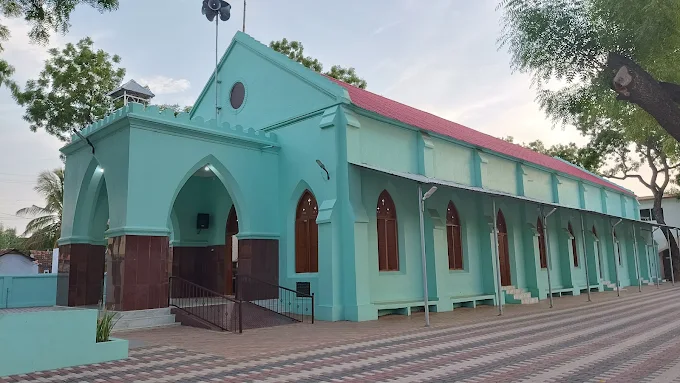
The development of a permanent church building marked another stage in the history of the congregation. Adventist archival reporting describes a church building at Pragasapuram as newly completed in the early 1920s and dedicated by Elder Spicer in October 1921. A 1922 General Conference Bulletin records the building and emphasizes substantial local financial participation. The date is important because it demonstrates the transition from a church meeting in improvised spaces to a congregation with a permanent place of worship.
The building was not merely a construction project. It represented the confidence of local believers in the future of the church. The financial participation of Indian members deserves particular emphasis. The physical history of the Mother Church was a shared achievement.
Missionaries contributed leadership and organizational support, while local believers contributed land, labour, resources, loyalty and community relationships. The church building also strengthened Pragasapuram's role as a regional gathering point. As new congregations appeared elsewhere, Pragasapuram remained a place to which Adventists could return for fellowship, meetings, anniversaries and remembrance. The building should therefore be understood as part of a larger heritage landscape.
The historic significance of Pragasapuram lies in the combination of the congregation, worship site, school campus, mission residences, photographs, records and the memories of families who participated in the work. Later generations would see changes in buildings, school arrangements and denominational administration. Yet the church's identity as the Mother Church remained attached to the original story. Buildings could be renovated or replaced; the historical role of the congregation could not be transferred to another place.
Indian Leadership and the Deepening Roots of the Mother Church
The maturity of the Pragasapuram church can be seen most clearly in the emergence of Indian leadership. E. D. Thomas and V. D. Koilpillai were not simply helpers to foreign missionaries. Their careers became part of the leadership structure of Adventism in South India. Thomas worked as a language teacher and translator, helped establish the mission and school, taught, conducted evangelistic meetings and later served in mission administration.
ESDA records that between 1915 and 1927 he baptized 69 individuals and that he helped organize the first Sabbath School in Kerala at Pullikottukonam, later known as Adventpuram. Koilpillai's story is equally closely connected with Pragasapuram. He was born into a local Sabbath-keeping family, received his education in the developing Adventist school system, began teaching at Pragasapuram in 1917, became headmaster by 1923, was ordained in 1931, and later served as principal and pastor at Pragasapuram as well as in wider mission leadership. Koilpillai's later service extended to the North Tamil Mission, South Tamil Mission and South India Union.
ESDA credits him with helping establish churches in Madurai and in the Malayalam field and with training pastors in public evangelism. His career illustrates how leadership generated in a local congregation could influence the wider church. This pattern gives the Mother Church a distinctive historical meaning. A mother is a source of life and continuity.
In institutional terms, Pragasapuram generated not only a congregation but people who carried Adventism into new territories. The church's legacy is therefore measured partly by the workers who emerged from it. The transition from foreign missionary leadership to increasingly strong Indian leadership was gradual. It involved education, experience, language competence, pastoral formation and denominational responsibility.
Pragasapuram was one of the places where that transition became visible.
Pragasapuram Through the Middle Decades, 1930–1959
The period from the 1930's to the late 1950's brought significant institutional change. The school experienced upgrades, retrenchment, relocation and re-establishment, while the church continued to function as the historical centre of the Pragasapuram Adventist community. The school reached the tenth-standard level in 1939. The years 1943–1946 were difficult, however, and high-school work was temporarily reduced.
High-school students were sent to Lowry Memorial High School at Krishnarajapuram, and in 1946 high-school standards were restored under the name James High School. A major relocation followed. In 1950 the South India Union authorized the purchase of land near Tanjore for the Tamil High School. The new E. D. Thomas Memorial High School opened at Kudikadu on July 30, 1953. This removed the senior school function from Pragasapuram but did not remove the congregation's historical importance. Indeed, the reaction of local members demonstrated how deeply education had become part of the community's identity.
The Union recognized the need to preserve an educational institution at the historic site, and boarding education returned in June 1956, initially at the lower standards. The church itself continued as a place of worship, baptism, fellowship and regional gathering. The 1958 Golden Jubilee was especially important. Adventist reporting records representatives from 48 churches and companies from the North and South Tamil fields.
The program included a historical presentation and the unveiling of a large portrait of J. S. James. The Jubilee was not simply a school anniversary.
It demonstrated that the wider Tamil Adventist community understood Pragasapuram as its historical ground. The Mother Church had survived institutional changes because its significance was rooted in the congregation's origin and continuing witness.
The Church in the Era of Indian Leadership, 1960–1989
By the 1960's and 1970's Pragasapuram had entered a different phase. The pioneering generation had passed, and Indian workers increasingly carried the work. The church continued to function as a regional gathering place and as a location associated with the memory of the pioneers. Adventist reporting described Pragasapuram in 1969 as the "ground of the pioneers." A Tamil Section constituency meeting held there demonstrated that the historic congregation retained practical significance within the wider church.
Regional meetings continued to bring believers from surrounding congregations to Pragasapuram. The church functioned as a place of worship, administration, fellowship and remembrance. The congregation's role was therefore not frozen in the past; it continued to participate in the active life of the field. The school continued alongside the church, first through the elementary boarding model and later through secondary education.
During the 1970's the institution developed as James Memorial High School. The educational story is treated separately later in this history because the school, although important, is not the primary reason Pragasapuram is called the Mother Church. One recurring institutional issue was the relationship between Adventist Sabbath observance and government examinations. The church and school sought ways to provide recognized academic qualifications without compromising the Sabbath convictions that had been central to the Pragasapuram movement from the beginning.
In 1987 the school received permission for tenth-standard matriculation, and in 1989 the Tamil Nadu Government authorized Plus One classes. Four classrooms and two laboratories were constructed in the Thambakara block in 1989. These developments show that the historic campus was adapting to modern educational requirements while retaining its Adventist identity. The church, however, remained the symbolic heart of the site.
The modernizing school could change its curriculum, buildings and administrative arrangements, but the congregation continued to embody the story that began in 1908 and reached formal organization in 1915.
The Mother Church and Its Continuing Heritage, 1990–2026
The contemporary period is characterized by modernization, heritage preservation and the continuing interaction of church and school. The supplied history records major school developments in 1990, 1991, 1999, 2004, 2010, 2013 and 2019. These changes are significant because they show that the historic site remained a functioning institutional campus rather than becoming merely a museum. For the church, the most important contemporary milestone was the centenary of formal organization in 2015.
The anniversary marked one hundred years since January 30, 1915. It should not be confused with the 1908 mission anniversary. Together, the two dates describe the first seven years of development from mission station to organized church. The 2019 renovation of the oldest administrative building was explicitly connected with heritage.
The stated purpose included helping younger generations appreciate the work of the pioneers. This is an important principle for the Mother Church: preservation is not simply the protection of old structures; it is the preservation of memory and meaning. The records fall short of inventing a complete list of pastors, elders, current membership figures or current officeholders. Such information should be added only from church and conference records.
The same caution applies to 2021–2026 school leadership and present institutional statistics. What can be stated with confidence from the published sources is that Pragasapuram remains historically important because permanent Adventist mission work began there in 1908, the first organized Adventist church in South India was organized there in 1915, early Adventist education developed there, and Indian leaders emerged from the Pragasapuram story. The contemporary responsibility is therefore twofold: the congregation must continue its life as a worshipping church, and the community must preserve the historical record that explains why this congregation has a unique place in South Indian Adventist history.
The School: From Mission Classroom to James Memorial Institution
The school is an essential part of the Pragasapuram story, but it should be understood as growing out of the mission and church rather than replacing them in the historical narrative. Education was present from the earliest days because the missionaries and local believers understood Christian schooling as part of the mission. Minnie James's instruction of six teenage girls in the James residence and verandah represents the earliest educational phase. As the Adventist community grew and some children lost access to schools operated by other missions, the need for a regular Adventist school became urgent.
On November 1, 1909, the first formal Adventist school was established in a rented building with an early enrollment of about 35 students, quickly rising to about 60. ESDA's school history likewise records 35 students and two tutors at the opening, followed by rapid growth. Gentry and Bertha Lowry joined the Pragasapuram team around 1909–1910. Gentry Lowry helped administer the school, prepared Bible lessons and built a schoolhouse of mud and brick.
The local Sabbath-keeping community donated a small plot of approximately two acres, additional land was purchased, and boarding facilities were developed for girls and boys. By 1913 the school had approximately 100 students—68 boys and 32 girls—with five teachers and a headmaster. The school was not simply an academic institution. It was intended to prepare young people for Christian service.
Students later moved into Adventist training institutions, and the school became part of the pipeline that produced teachers, evangelists and other workers. In 1919–1920 the institution was renamed the Tamil Mission School because it served the wider Tamil Mission of the South India Union. Later names included Tamil Intermediate School, Tamil High School, Prakasapuram High School, Prakasapuram Secondary Boarding School, James High School, James Elementary Boarding School, James Memorial High School and James Memorial Higher Secondary School.
The School's Institutional Development and Leadership
The school's long institutional history helps explain the endurance of the Pragasapuram campus. In 1928 a government school inspector visited and invited the institution to seek government registration. Contemporary school history records that the workers continued to emphasize its mission-school character rather than immediately pursuing such recognition. The school reached tenth-standard level in 1939.
Financial and institutional pressures then produced the 1943–1946 transition, including the temporary reduction to elementary boarding level. High-school work was restored in 1946 under the name James High School. The relocation to Kudikadu in 1953 was a major institutional turning point. The senior school moved, but the Pragasapuram community retained an educational presence.
Boarding education returned in 1956. The later decades saw the institution develop toward secondary and higher-secondary education. The leadership succession is itself a historical record. Early leaders included J. S. James and E. D. Thomas; later came H. W. Carter, E. D. Willmott, C. A. Randolph, O. A. Skau, G. Gurubatham and V. D. Koilpillai. The post-1950s and modern succession included many Indian educators and administrators.
The later school developed as James Memorial High School and then James Memorial Higher Secondary School. ESDA records new boys' hostel facilities in 1990 and 2010, a new kitchen in 1991 with World Vision support, a new elementary block in 1999, laboratories in 2004 and an eight-classroom ICSE building in 2013 funded through a Thirteenth Sabbath School Offering. In 2019 the oldest administrative building was renovated, with the heritage purpose of helping younger generations appreciate the pioneers. The school therefore became one of the principal custodians of the physical memory of the Pragasapuram mission.
The school's story should always be linked to the church. It helped educate generations of young people, supported the development of workers and preserved the James name, but its historical meaning is strongest when seen as part of the wider mission that produced the Mother Church.
People Who Carried the Pragasapuram Story Forward
Judson Spray James was the principal missionary pioneer associated with the establishment of Adventist work in South India. His work at Pragasapuram combined Bible study, preaching, education, health service, language learning and institutional development. His name remained attached to the school long after his missionary assignment ended.
Minnie Louise James's contribution was particularly important in education. Her early instruction of six girls in the family residence and on the verandah is one of the clearest examples of how the educational ministry began on a household scale before developing into a formal school.
Edward Duraiswamy Thomas was among the twenty baptized in 1910. He became a teacher, translator, evangelist and administrator and helped bridge the pioneer missionary period and the emergence of Indian Adventist leadership. His later ministry extended beyond Pragasapuram into the wider South Indian field.
Vethanayagam Duraisamy Koilpillai was born at Pragasapuram in 1899, baptized in 1912, taught at the school from 1917, became headmaster by 1923 and was ordained in 1931. He later served as principal, pastor and mission administrator. His career is one of the strongest examples of local leadership growing from the Mother Church.
Gentry and Bertha Lowry joined the Pragasapuram team around 1909–1910. Gentry Lowry helped develop the school and its facilities, while the Lowry contribution also belongs to the larger story of training indigenous workers and building a sustainable South Indian Adventist mission. These individuals should not be remembered as isolated heroes. Their importance lies in the network they formed with local believers and families.
The Pragasapuram story became durable because leadership was progressively shared, reproduced and carried into new communities.
Pragasapuram and the Expansion of Adventism in South India
The Mother Church became significant because its influence travelled. Students became teachers. Teachers became evangelists. Evangelists helped organize new congregations.
Pastors trained in the developing South Indian Adventist system served across Tamil-speaking and Malayalam-speaking areas. Edward Thomas's later ministry in Kerala illustrates this geographical expansion. Koilpillai's service in Madurai and the Malayalam field provides another example. The supplied history describes Pragasapuram as a feeder into the wider Adventist educational and evangelistic pipeline.
The school's boarding system also contributed to the process. Young people from different places could live and study in an Adventist environment, receive biblical instruction and encounter the idea of Christian service. Some later moved to higher Adventist training institutions. The wider mission combined preaching with practical work.
Early records mention dispensary service, agriculture, literature work and educational activity. This integrated approach reflected the Adventist understanding that evangelism included the whole life of a community. The Pragasapuram congregation therefore functioned as a sending centre. Its significance was not confined to the number of people worshipping there at any one moment.
Its historical reach can be traced through people who carried ideas, skills, institutions and faith into other places. This is one reason the word "Mother" is appropriate historically. The congregation was a point of origin for organized Adventism in South India and a source from which workers and congregational influence spread. The Mother Church's story is therefore inseparable from the story of the churches that later developed elsewhere.
Why Pragasapuram Is Called the Mother Church
The title "Mother Church" rests on several documented foundations. Permanent Adventist mission work was established at Pragasapuram in 1908. The first organized Seventh-day Adventist church in South India was formally organized at Pragasapuram on January 30, 1915, with 49 baptized members according to the archival-based supplied history. The congregation developed from sustained Bible study, baptism, Sabbath worship and local participation rather than being created solely by an administrative decision.
Early Adventist education was established at the mission and became a major means of training future workers. Indian Adventist leaders such as Edward D. Thomas and V. D. Koilpillai emerged from the Pragasapuram story.
The church served as a regional gathering and mission centre as Adventism expanded across South India. The historic campus preserves physical and institutional links with the earliest period of organized Adventism in the region. The title therefore describes historical origin, not merely age.
Other Adventist congregations may be old, influential or large, but Pragasapuram occupies a particular place because organized Adventist church life in South India was formally established here. The Mother Church identity also carries a responsibility. A mother church is expected to remember where the movement came from, preserve its records and transmit its story accurately. The historical task is therefore not to enlarge the story with unsupported claims but to protect what can be demonstrated and to identify what still needs documentation.
A Heritage That Is More Than Buildings
Pragasapuram's heritage cannot be reduced to a church building, a school block or an old photograph. Its heritage is the accumulated relationship between people, faith, institutions and place. The earliest heritage is human: the Sabbath keepers who welcomed the missionaries; the James family who moved into the community; the Koilpillai family and other local believers who assisted the work; the converts who accepted baptism; the teachers and students who sustained the school; and the Indian workers who carried the movement beyond Pragasapuram. The second layer is institutional: the organized congregation of 1915, the mission structure, the school, boarding facilities, dispensary, agricultural activities and regional meetings.
These institutions were expressions of a shared Adventist mission. The third layer is physical: the historic church building, mission residences, school buildings, hostels, laboratories and renovated heritage structures. Physical preservation matters because buildings provide tangible links with the people who used them. The fourth layer is documentary: church registers, baptismal records, minutes, school annual reports, anniversary souvenirs, photographs, letters and denominational publications.
Without these records, future generations will know the general story but may lose the details that make the story verifiable. The fifth layer is oral memory. Senior members and pioneer families may preserve details not found in printed sources. Such testimony should be recorded, attributed and compared with documentary evidence.
Oral history should neither be dismissed nor automatically treated as exact. Pragasapuram's heritage is strongest when all five layers are preserved together. The church is the heart; the school is an important companion institution; the records and buildings are the memory; and the people are the living connection between past and present.
Master timeline
Milestones drawn from the supplied church record, from 1857 to the present period.
1857
Sattampillai’s independent Indian Christian movement developed in the Tirunelveli region, including seventh-day Sabbath observance.
1893–1894
News and Adventist literature began connecting South Indian Sabbath keepers with Adventists abroad.
1907
James, John L. Shaw and G. F. Enoch visited the Sabbath-keeping community.
March 17, 1908
Judson and Minnie James moved into the area and permanent Adventist mission work began.
November 1, 1909
The first formal Adventist school opened with about 35 students.
April 2, 1910
Twenty people were baptized in the first major group baptism.
January 30, 1915
The first organized Seventh-day Adventist church in South India was formed with 49 baptized members.
October 1921
The historic Pragasapuram church building was dedicated.
1958
Representatives from 48 churches and companies gathered for the Golden Jubilee.
1969
Adventist reports described Pragasapuram as the “ground of the pioneers.”
1987–1989
The school gained matriculation and Plus One permissions and expanded its classrooms and laboratories.
2015
The Mother Church marked the centenary of its formal organization.
2019
The oldest administrative building was renovated as a heritage-preservation project.
2021–2026
Current church and school details await verification from local records.
Sources and historical notes
- This page follows the English history supplied by the church. The companion Tamil view follows the separately supplied Tamil record rather than translating this page at runtime.
- The account draws on the Encyclopedia of Seventh-day Adventists, denominational periodicals, school histories and local compiled records cited in the supplied documents.
- The December 1907 exploratory visit, the beginning of permanent mission work on March 17, 1908, and the formal organization of the church on January 30, 1915 are distinct events.
- Some secondary accounts give 50 members at organization; the archival-based history uses 49. Current church, school and leadership details for 2021–2026 require confirmation from local records.